
The Great Pyramid of Khufu is the only surviving Wonder of the Ancient World. Built around 2560 BC using 2.3 million stone blocks, it stood as the tallest man-made structure on Earth for 3,800 years. The Giza Plateau has been continuously settled ever since — and the villages surrounding it today are part of the same unbroken story.
Giza is defined by its pyramids — the Great Pyramid of Khufu, the Pyramid of Khafre, and the Pyramid of Menkaure — but the plateau holds far more than its monuments. The local culture of Giza has evolved around these ancient structures for thousands of years. The people who live in the plateau today — many from families that have worked here for generations — still make their living within sight of the structures their ancestors built.
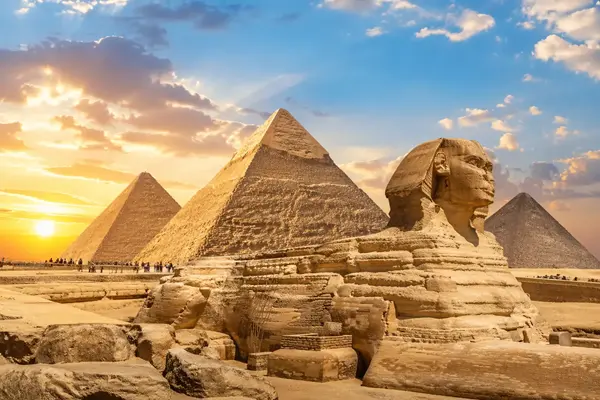
Giza Pyramids & Great Sphinx · Elias Tours Egypt
The largest structure ever built by human hands — 2.3 million stone blocks, 140 meters high, constructed over 20 years with precision that still defies modern engineering.
The world’s largest monolithic statue was carved from a single limestone outcrop in the Giza Plateau. Generally attributed to Pharaoh Khafre around 2500 BC, though the exact date and builder remain debated. The original nose was deliberately removed — most likely during the medieval period.
One of the best-preserved Old Kingdom temples in Egypt, built from massive granite blocks. This is where the mummification of Pharaoh Khafre is believed to have been completed.
The reconstructed 4,600-year-old cedar solar boat of Khufu — one of the oldest and most complete vessels ever discovered — now housed at the base of the Great Pyramid.
The villages surrounding the plateau have preserved a traditional way of life — camel herders, craftsmen, and families who have lived alongside these monuments for generations.
The southern plateau offers the iconic shot where all nine pyramids align in a single frame — the most photographed view in human history, and still breathtaking every single time.
“When you stand before the Great Pyramid for the first time, you do not need a guide to explain the magnitude. You just feel it.”
Mostapha Kamal · Licensed Egyptologist & Founder, Elias Tours EgyptFour focused hours at the Giza Plateau with a private Egyptologist — Great Pyramid, Sphinx, Valley Temple, and the panoramic viewpoint.
ExploreSee the treasures in the museum first, then stand before the monuments that housed them — the ultimate Giza experience.
ExploreStep further back — see where pyramid building began with the Step Pyramid and the Bent Pyramid, the experimental precursors to Giza’s perfection.
ExploreOur licensed Egyptologist guides bring every site to life with story, depth, and genuine local knowledge — no crowds, no scripts, just authentic Egypt.
Book a Private Touror call directly
+20 151 521 3040
Questions
The Giza plateau typically takes 2–3 hours for a focused visit covering the three main pyramids, the Great Sphinx, and the Valley Temple. A half-day tour (4 hours) allows more time at each site and includes the Grand Egyptian Museum nearby.
Yes — the interior of Khufu’s Great Pyramid, Khafre’s Pyramid, and the Menkaure complex are open to visitors for an additional ticket. The chambers are narrow and low, requiring some crouching. Not recommended for those with claustrophobia.
The GEM opened in 2023 adjacent to the Giza plateau. It houses over 100,000 artefacts including the complete Tutankhamun collection — previously split across multiple Cairo museums. Combining GEM with the Pyramids on the same day is the most efficient itinerary.
The plateau itself is walkable, but it is large — around 2km from entrance to the farthest pyramid. A private guide with transport covers the site more efficiently and avoids the persistent offers from camel and horse handlers.
Early morning — 8:00 to 10:00 AM — has the best light for photography and the fewest visitors. Midday in summer is extremely hot and crowded. The site closes at 5 PM.
Explore Egypt · All Destinations